
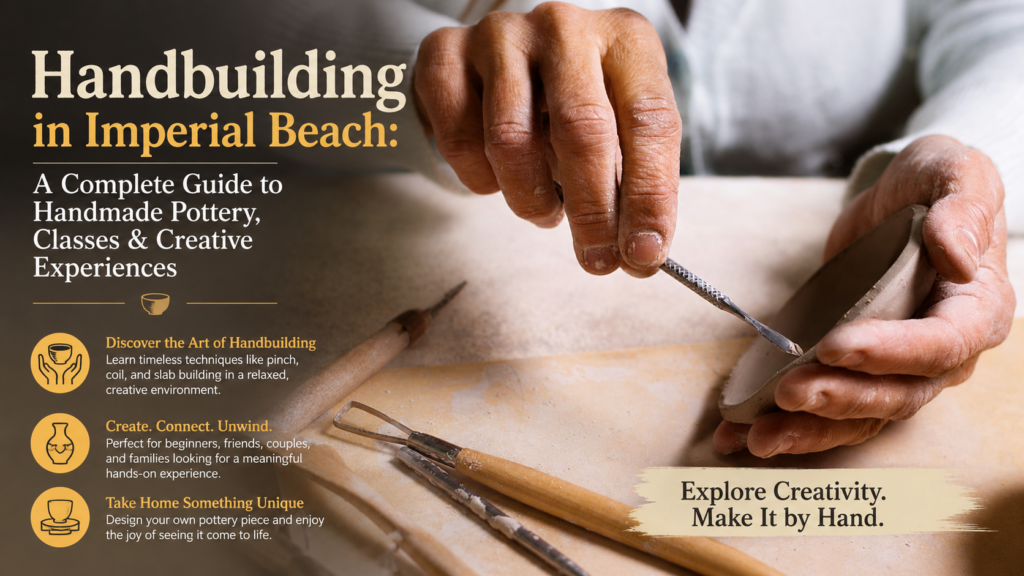
Have you ever wanted to create something beautiful with your own hands? Handbuilding in Imperial Beach offers a creative and relaxing way to explore pottery without using a spinning pottery wheel.
From simple clay bowls to decorative sculptures, handbuilding allows you to shape clay with your hands and basic pottery tools. You can create unique pieces while learning how clay responds to pressure, moisture, texture, and shape.
At Art Wheel in Imperial Beach, handbuilding provides a hands-on ceramics experience for people who want to explore their creativity. Whether you are completely new to pottery or already enjoy working with clay, handbuilding gives you the freedom to turn an idea into something tangible.
In this guide, you will learn what handbuilding pottery is, how the process works, the three main handbuilding techniques, what beginners can make, and why Imperial Beach is a great place to explore this creative activity.
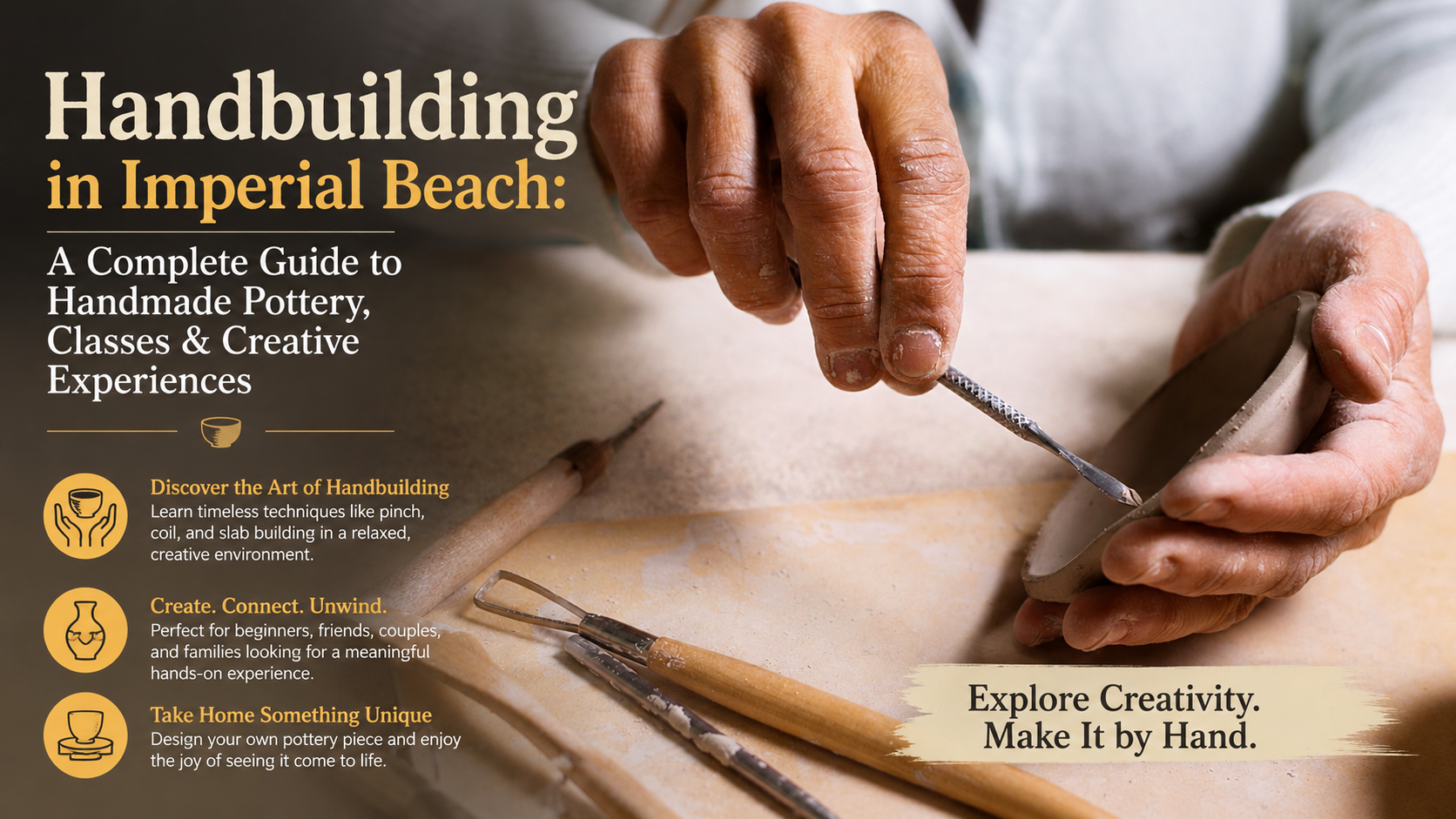
What Is Handbuilding Pottery?
Handbuilding is a pottery technique in which clay is shaped primarily by hand instead of being formed on a rotating pottery wheel.
In simple terms, handbuilding means making pottery by hand.
Artists can pinch, press, roll, cut, shape, and join clay to create different forms. Unlike wheel throwing, handbuilding does not require every piece to have a perfectly symmetrical shape.
As a result, you have more freedom to experiment with organic, abstract, textured, and personalized designs.
Handbuilding is also one of the oldest ways of working with clay. People have used similar techniques for thousands of years to create functional and decorative objects.
Today, handbuilding remains popular because it is:
- Beginner-friendly
- Creative and flexible
- Relaxing
- Suitable for different age groups
- Ideal for unique pottery
- Great for personal expression
If you are looking for a creative activity in Southern California, handbuilding in Imperial Beach can be a wonderful way to experience pottery and create something yourself.
Handbuilding in Imperial Beach
When searching for handbuilding in Imperial Beach, you may find different types of pottery experiences. Some are longer courses, while others are introductory workshops designed to help beginners discover clay.
For someone attending their first pottery class, a beginner-friendly handbuilding experience can be an excellent starting point.
At Art Wheel, participants work with clay at a table rather than on a pottery wheel. This allows them to explore basic techniques while creating their own pottery, decorative objects, or simple sculptures.
One of the main advantages of handbuilding is its flexibility.
You are not limited to perfectly symmetrical forms. Instead, you can create something organic, sculptural, textured, playful, or completely unique.
What Are the Three Basic Handbuilding Methods?
If you are new to pottery, you may wonder, what are the three basic handbuilding methods?
The three fundamental techniques are:
- Pinch pottery
- Coil building
- Slab building
Each method has its own process and creative possibilities.
Let’s take a closer look.
1. Pinch Pottery
Pinch pottery is one of the simplest handbuilding techniques.
You start with a ball of clay and use your fingers and thumb to gradually press and shape it.
The basic process includes:
- Forming a ball of clay
- Creating an opening with your thumb
- Supporting the outside with your fingers
- Pinching the clay walls
- Refining the shape
- Smoothing or adding texture
Pinch pots are excellent beginner projects because you can immediately feel how clay responds to your hands.
You can use this technique to make:
- Small bowls
- Cups
- Dishes
- Decorative objects
- Sculptural forms
- Small planters
Once you understand the basic technique, you can also use pinch pottery as the foundation for more advanced projects.
2. Coil Building
Coil building involves creating long, rope-like pieces of clay called coils.
These coils are placed on top of one another and joined together to build the walls of a pottery piece.
The process usually involves:
- Rolling clay into long coils
- Creating a clay base
- Placing the coils around the base
- Joining the coils
- Building upward
- Smoothing the surface or leaving the coils visible
- Refining the final shape
Coil building is particularly useful for creating larger or more sculptural pieces.
You can make:
- Tall vessels
- Sculptures
- Planters
- Decorative jars
- Organic forms
It also provides plenty of opportunities to experiment with surface texture.
3. Slab Building
Slab building involves rolling or pressing clay into relatively flat sheets.
These slabs can then be cut, shaped, folded, bent, and joined to create pottery.
Slab techniques can be used to make:
- Plates
- Trays
- Boxes
- Mugs
- Planters
- Wall pieces
- Geometric sculptures
This method is especially useful when you want to create straight edges, architectural forms, or structured designs.
Which Handbuilding Technique Is Best for Beginners?
There is no single technique that is best for everyone.
However, pinch pottery is often a good starting point because it requires minimal equipment. It also lets you immediately understand how clay responds to your hands.
On the other hand, coil building is ideal if you enjoy creating sculptural forms and building upward.
Meanwhile, slab building can be a good choice if you enjoy geometry, patterns, and structured designs.
A beginner pottery class can introduce you to one or more techniques. From there, you can discover which approach best matches your creative style.
Is Handbuilding Pottery Easy?
A common beginner question is, is handbuilding pottery easy?
The short answer is that handbuilding is accessible to beginners, but developing advanced pottery skills takes practice.
You do not need previous pottery experience to get started. However, creating a strong and well-balanced piece requires you to learn how to control several factors.
These include:
- Clay moisture
- Wall thickness
- Joining techniques
- Drying
- Pressure
- Shape
- Surface texture
- Structural support
Your first project may not be perfect, and that is completely normal.
The purpose of a beginner class is not to create museum-quality pottery immediately. Instead, you are learning how the material behaves, practicing fundamental techniques, and enjoying the creative process.
Why Is Handbuilding Great for Beginners?
Handbuilding has several advantages for people who have never taken a ceramics class.
No Pottery Wheel Required
If learning to operate a spinning pottery wheel feels intimidating, handbuilding provides a simpler starting point.
You can focus on the clay itself without worrying about controlling a rotating surface.
More Freedom of Shape
Handbuilding allows you to create irregular, organic, and sculptural forms.
You are not limited to the symmetrical shapes often associated with wheel throwing.
Easy to Experiment With
You can add:
- Textures
- Impressions
- Patterns
- Handles
- Decorative elements
- Sculptural details
This gives you plenty of room to experiment.
Suitable for Different Skill Levels
A beginner can make a simple bowl, while an experienced ceramic artist can create detailed sculptural work.
Encourages Creativity
Most importantly, handbuilding gives you the freedom to turn an idea into a physical object.
Handmade Pottery in Imperial Beach
One of the most appealing aspects of handbuilding is that the finished piece is genuinely handmade.
Every fingerprint, curve, texture, and small variation can become part of its character.
Unlike mass-produced ceramics, handmade pottery can have subtle differences that make each piece feel personal.
For beginners, this can make the experience particularly rewarding.
You are not simply buying a finished object. Instead, you are participating in the process of creating it.
A simple lump of clay gradually becomes something that reflects your ideas and choices.
What Can You Make in a Handbuilding Class?
One of the most exciting things about handbuilding is the variety of projects you can create.
Ceramic Bowls
Bowls are popular beginner projects.
You can create a simple functional bowl or experiment with textures and decorative details.
Mugs
Mugs allow you to explore handles, shapes, and surface decoration.
Plates and Trays
Slab building is particularly useful for making plates and trays with structured shapes.
Planters
Handbuilt planters can be customized with textures, patterns, and unique forms.
Sculptures
If you prefer artistic projects, handbuilding gives you the freedom to create sculptures and imaginative forms.
Decorative Pieces
You can also create small ornaments, dishes, wall pieces, and personalized objects.
The possibilities depend on your creativity and the type of class you choose.
What Is the Basic Handbuilding Process?
Although every pottery project is different, most handbuilding projects follow a series of basic steps.
Step 1: Prepare the Clay
First, the clay needs to be prepared so it has a workable consistency.
Potters may knead or wedge clay to improve its consistency and reduce unwanted air pockets.
Step 2: Choose a Technique
Next, choose the technique that fits your project.
You can work with:
- Pinch
- Coil
- Slab
Your choice will depend on the size, shape, and style you want to create.
Step 3: Shape the Clay
Now the creative process begins.
Use your hands and appropriate pottery tools to create the basic form. Work gradually and make small adjustments as you go.
Step 4: Add Details
Once the basic shape is ready, you can add details such as:
- Texture
- Patterns
- Handles
- Carved designs
- Stamps
- Decorative elements
This is where you can give the piece your own personality.
Step 5: Let the Clay Dry
After shaping, the pottery needs to dry before firing.
Drying should be handled carefully because uneven or rapid drying can cause problems with some pieces.
Step 6: Fire the Pottery
Once the clay has dried sufficiently, it can be fired in a kiln.
The high temperature transforms the dried clay into a stronger ceramic material.
Step 7: Apply Glaze
Depending on the project, glaze can be added to provide color, texture, and a finished surface.
The piece may then be fired again.
After the final firing, the handmade pottery is ready to be enjoyed.
Handbuilding vs. Wheel Throwing
Both handbuilding and wheel throwing are popular ways to make pottery. However, they provide different experiences.
| Handbuilding | Wheel Throwing |
|---|---|
| Uses hands and simple tools | Uses a rotating pottery wheel |
| Great for organic shapes | Great for symmetrical forms |
| Beginner-friendly | Requires wheel-control practice |
| Excellent for sculptures | Excellent for bowls and vessels |
| Allows extensive surface decoration | Focuses strongly on shaping and throwing |
| No wheel required | Requires pottery wheel equipment |
Neither method is automatically better.
Instead, the right choice depends on what you want to create and how you prefer to work with clay.
Many pottery enthusiasts eventually enjoy both techniques.
Things to Do in Imperial Beach
If you’re wondering what to do in Imperial Beach, pottery can be an interesting addition to the many activities available in this coastal community.
Depending on your interests, you can enjoy:
- Beach time
- Waterfront walks
- Local restaurants
- Outdoor recreation
- Art workshops
- Pottery experiences
- Community events
- Photography
- Creative classes
A handbuilding workshop offers something different from a typical beach visit.
Instead of simply exploring the area, you can participate in a creative activity and make something you can keep.
This can make handbuilding an appealing option for visitors, couples, families, friends, and local residents.
Handbuilding for Families and Kids
Handbuilding can also be an enjoyable family activity.
Children can use clay to create simple forms, animals, decorative pieces, and imaginative projects.
Because the technique does not require a pottery wheel, younger participants can focus on shaping the clay with their hands and exploring different textures.
A family pottery session can also encourage collaboration. Parents can help with the process while children make their own creative decisions.
The result is not just a pottery piece. It is also a shared experience.
Handbuilding for Couples
Looking for an unusual date activity?
A pottery handbuilding class can be a creative alternative to a traditional dinner or movie.
You can work side-by-side, experiment with clay, and create individual pieces.
It also gives you an opportunity to try something new together.
Instead of simply taking photos or watching a movie, you can create something that reminds you of the experience.
Handbuilding for Friends
Handbuilding can also work well as a group activity.
Friends can:
- Try different techniques
- Create individual pieces
- Share ideas
- Experiment with textures
- Take photos
- Enjoy a creative environment
Since participants can work at a table, the activity can also encourage conversation and interaction.
What Is the Difference Between Handmade and Handbuilding?
The terms handmade and handbuilding are related, but they do not mean exactly the same thing.
Handbuilding is a specific pottery technique where clay is shaped by hand.
Handmade is a broader term for something created by hand rather than mass-produced.
Therefore, handbuilding pottery is handmade, but handmade pottery does not always involve handbuilding.
For example, a potter can create a bowl on a wheel and then add a handmade handle or decorative element.
Famous Pueblo Pottery Artists
Pottery has a rich cultural history, particularly among Indigenous communities in the American Southwest.
If you are interested in famous Pueblo pottery artists, several names are important to the history of Native American ceramics.
Maria Martinez
Maria Martinez of San Ildefonso Pueblo is one of the most recognized Pueblo potters in American art history.
She became particularly well known for distinctive blackware pottery created with her husband, Julian Martinez.
Her work demonstrates how traditional knowledge, experimentation, and craftsmanship can influence generations of ceramic artists.
Nampeyo of Hano
Nampeyo was a renowned Hopi-Tewa potter from First Mesa in Arizona.
She is particularly known for reviving and adapting designs associated with ancestral Sikyatki pottery.
Her work became widely recognized and established her as one of the most influential Native American ceramic artists.
Lucy Martin Lewis
Lucy Martin Lewis of Acoma Pueblo was another important figure in Pueblo pottery.
Her work helped preserve and advance traditional Acoma pottery techniques and artistic traditions.
Margaret Tafoya
Margaret Tafoya of Santa Clara Pueblo became known for large blackware vessels and traditional pottery.
Her work and teaching helped continue Santa Clara pottery traditions for future generations.
Helen Cordero
Helen Cordero of Cochiti Pueblo is especially famous for her storyteller figures.
Her work demonstrates how pottery can move beyond traditional vessels and become a form of storytelling and cultural expression.
Blue Corn
Blue Corn of San Ildefonso Pueblo was another influential Pueblo ceramic artist.
Her work contributed to the continuation and development of San Ildefonso pottery traditions.
Learning about these artists can help beginners understand that pottery is more than a simple craft. It can also represent cultural heritage, storytelling, identity, and artistic expression.
What Can Beginners Learn From Pueblo Pottery?
Pueblo pottery can provide inspiration for modern ceramic artists.
Students can observe how traditional potters work with:
- Natural forms
- Geometric patterns
- Surface decoration
- Polished surfaces
- Functional shapes
- Storytelling
However, cultural traditions should always be approached respectfully.
Learning about the history and meaning behind traditional pottery is more appropriate than simply copying culturally significant designs.
Is Handbuilding Better Than Wheel Throwing?
Not necessarily.
The better technique depends on your interests and goals.
If you enjoy sculpting and creating unusual forms, handbuilding may be a better fit.
If you prefer symmetrical cups, bowls, and vases, wheel throwing may appeal to you more.
If you’re unsure, handbuilding can be an approachable way to become comfortable with clay before trying the pottery wheel.
Is Handbuilding Pottery Messy?
Yes, pottery can be messy.
Clay and water are part of the process, which is why pottery studios use washable work surfaces and equipment.
When attending a beginner pottery class, wear comfortable clothing that you do not mind getting dirty.
You should also avoid expensive clothing or accessories that could be damaged by clay.
The mess is simply part of the creative experience.
What Should You Bring to a Handbuilding Class?
For most introductory pottery experiences, you do not need a large collection of specialized tools.
Depending on the studio, basic clay, tools, and other materials may be provided.
You may want to bring:
- Comfortable clothing
- Closed-toe shoes
- A hair tie if you have long hair
- A water bottle
- Patience
- Creativity
Most importantly, come ready to experiment and learn.
How Long Does Handbuilding Take?
The time required depends on the project.
A simple pinch bowl can be made relatively quickly. In contrast, a detailed sculpture may require much more time.
Also, shaping the clay is only one part of the process.
The piece must dry before firing. Afterward, it may be glazed and fired again.
Therefore, the complete pottery process can take considerably longer than the initial class.
What Happens to Your Pottery After You Make It?
A handmade pottery piece typically goes through several stages.
1. Shaping
You create the basic form using your chosen handbuilding technique.
2. Drying
The piece is allowed to dry gradually.
3. Bisque Firing
The dried clay is fired in a kiln to create a stronger ceramic form.
4. Glazing
Glaze can add color, texture, and a finished surface.
5. Final Firing
The glazed pottery is fired again.
6. Finished Piece
After the final firing, the piece is ready to be displayed or used when appropriate.
This transformation is one reason pottery can feel so rewarding.
What starts as a simple piece of clay eventually becomes a finished object created by your own hands.
Tips for Your First Handbuilding Class
If you are attending your first pottery class, a few simple tips can make the experience more enjoyable.
Don’t Aim for Perfection
Your first project is primarily about learning.
Keep the Clay Thickness Consistent
Uneven walls can create problems during drying and firing.
Don’t Use Too Much Water
Excess water can make the clay soft and difficult to control.
Join Clay Pieces Properly
When attaching handles, coils, or other elements, make sure the pieces are joined securely.
Experiment With Texture
Try simple impressions and patterns to personalize your pottery.
Ask Questions
If you’re unsure about a technique, ask your instructor for guidance.
Enjoy the Process
The goal is not only to create a finished piece. The experience of working with clay is part of the fun.
Why Choose Art Wheel for Handbuilding in Imperial Beach?
Art Wheel provides a hands-on creative environment where beginners can explore pottery without needing previous experience.
Its handbuilding experience allows participants to work with clay at a table and create pottery pieces, decorative objects, or basic sculptures.
The studio also offers other pottery experiences, giving participants opportunities to discover different approaches to working with clay.
For anyone searching for handbuilding in Imperial Beach, the combination of hands-on creativity, beginner-friendly projects, and personal expression makes handbuilding an approachable way to discover pottery.
Frequently Asked Questions About Handbuilding in Imperial Beach
What is handbuilding pottery?
Handbuilding is the process of creating pottery by shaping clay with your hands and simple tools instead of using a pottery wheel.
What are the three basic handbuilding methods?
The three primary handbuilding methods are pinch pottery, coil building, and slab building.
Is handbuilding pottery easy?
Handbuilding is accessible to beginners, but developing advanced pottery skills takes practice. A beginner-friendly class can make the learning process easier.
Where can I learn handbuilding in Imperial Beach?
Art Wheel offers hands-on pottery experiences in Imperial Beach where participants can explore handbuilding techniques and create their own ceramic pieces.
What can I make during a handbuilding class?
Depending on the project, you can create bowls, mugs, plates, decorative objects, sculptures, planters, and other ceramic pieces.
Do I need previous pottery experience?
No. Handbuilding is suitable for beginners, and you can learn basic techniques without previous pottery experience.
Is handbuilding better for beginners than wheel throwing?
Handbuilding can be an approachable starting point because you do not need to learn how to control a spinning pottery wheel. However, both techniques can be learned by beginners with proper instruction.
Who are some famous Pueblo pottery artists?
Important Pueblo and Native American pottery artists include Maria Martinez, Nampeyo of Hano, Lucy Martin Lewis, Margaret Tafoya, Helen Cordero, and Blue Corn.
Why is Maria Martinez famous?
Maria Martinez is renowned for her San Ildefonso pottery, particularly the distinctive blackware tradition she developed with her husband, Julian Martinez.
Why is Nampeyo important in pottery history?
Nampeyo is known for reviving and adapting ancestral Sikyatki pottery forms and designs. She became one of the most influential Native American ceramic artists.
What should I wear to a handbuilding class?
Wear comfortable clothing and shoes that you do not mind getting dirty. Clay can be messy during the creative process.
Can children participate in handbuilding?
Some handbuilding classes are designed for children and families. Age requirements and projects can vary by studio, so check the specific class details before booking.
Discover Handbuilding in Imperial Beach at Art Wheel
If you have been searching for handbuilding in Imperial Beach, you don’t need to consider yourself an artist to get started.
Handbuilding is about experimentation, creativity, and learning how clay responds to your hands.
You can make a bowl, create a sculpture, experiment with texture, design a personalized gift, or simply enjoy a relaxing creative activity.
At Art Wheel, you can explore hands-on pottery and discover the satisfaction of creating something yourself.
Whether you’re looking for a new hobby, a fun activity with friends, a creative date idea, or a family experience, handbuilding in Imperial Beach can be a great way to spend your time.
Start with a simple piece of clay, explore your creativity, and enjoy the process of making something by hand.