
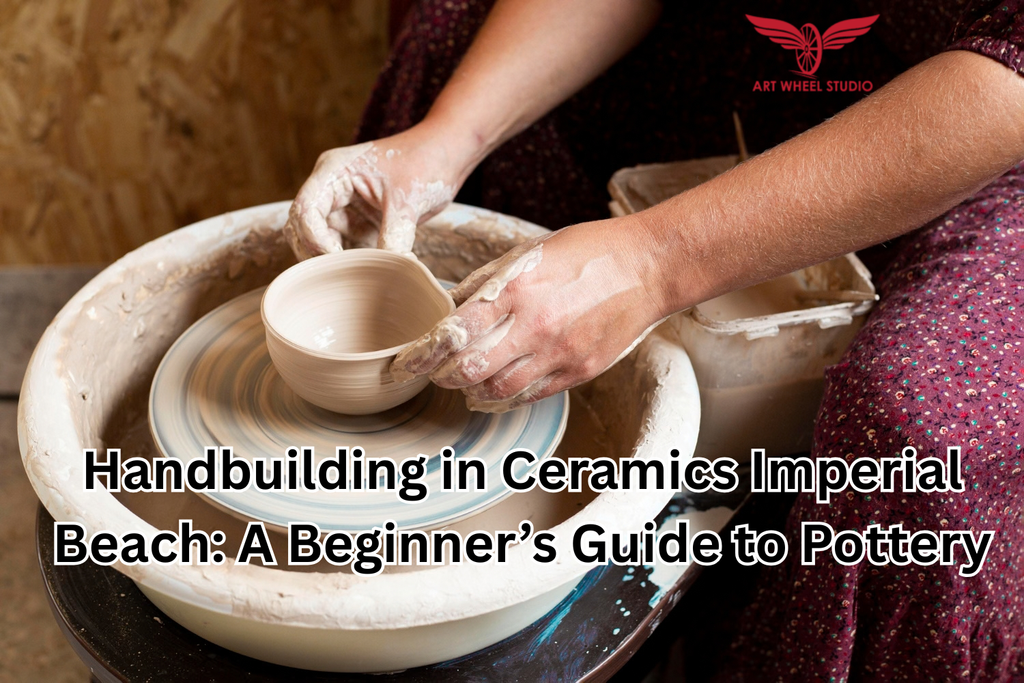
If you want to explore ceramics without starting at a pottery wheel, handbuilding in ceramics in Imperial Beach is a creative and relaxing way to begin. Handbuilding allows you to shape clay using your hands and simple tools instead of relying on a wheel. You can make bowls, small sculptures, decorative pieces, trays, planters, and many other unique forms.
At Art Wheel Studio in Imperial Beach, you can explore hands-on pottery and clay experiences in a relaxed studio environment. Art Wheel offers a dedicated handbuilding experience where participants work with clay at a table and create their own ceramic pieces. The experience is designed to be approachable for beginners while giving you room to experiment and express your creativity.
Whether you are searching for the best handbuilding in Imperial Beach, looking for a ceramics studio in San Diego, or simply want to try something new, handbuilding can be a rewarding introduction to pottery.

What Is Handbuilding in Ceramics?
Handbuilding is a traditional way of creating pottery without using a pottery wheel. Instead, artists use their hands, fingers, and basic ceramic tools to shape and construct clay.
The three main handbuilding methods are pinching, coiling, and slab building. These techniques can also be combined to create more complex forms.
Handbuilding gives you more direct contact with the clay. As a result, your fingerprints, textures, small variations, and design choices can become part of the finished piece.
Unlike wheel throwing, handbuilding does not require you to learn how to center clay on a spinning wheel. Therefore, it can be an excellent option for beginners, families, groups, and anyone who wants a slower and more sculptural ceramics experience.
Why Try Handbuilding in Imperial Beach?
Imperial Beach offers a relaxed coastal setting that can make a creative activity even more enjoyable. Instead of spending your free time doing another routine activity, you can work with clay and create something with your own hands.
A handbuilding in Imperial Beach experience can be a good choice if you:
- Are completely new to ceramics
- Want to try pottery without using a wheel
- Enjoy hands-on creative activities
- Want to make a personalized ceramic piece
- Are looking for a relaxing artistic experience
- Want to explore ceramics with friends
- Enjoy working with natural materials
- Want to develop basic pottery skills
Handbuilding is also flexible. You do not need to make a perfectly symmetrical pot. You can create organic shapes, textured surfaces, sculptural objects, or functional pottery.
The Three Main Methods of Handbuilding
1. Pinch Pottery
Pinching is one of the simplest ways to begin working with clay.
You start with a ball of clay and press your thumb into the center. Then, you gently pinch the clay between your thumb and fingers while rotating the form. This gradually creates an opening and develops the walls of the vessel.
Pinch pottery is especially useful for bowls and small vessels. It also teaches you how clay responds to pressure from your fingers.
For beginners, pinch pots are useful because you can immediately feel changes in wall thickness. You can also create organic shapes that have a handmade character.
2. Coil Building
Coil building involves rolling clay into long, rope-like pieces called coils. These coils are placed one on top of another and joined together to build the walls of a vessel or sculpture.
Coiling is useful when you want to create taller or more complex forms. You can gradually change the direction and width of the walls as you build.
However, the coils need to be properly joined. Simply placing one coil on another may leave a weak connection. The clay should be joined and blended carefully so that the structure becomes one continuous form.
3. Slab Building
Slab building uses flat sheets of clay. The clay is rolled to an even thickness and then cut into shapes that can be joined together.
This method is excellent for making:
- Plates
- Trays
- Boxes
- Tiles
- Rectangular planters
- Angular sculptures
- Geometric vessels
Slab construction can create forms with straight lines and sharp angles that may be more difficult to achieve on a pottery wheel.
You can also combine slabs with coils or pinch forms to create more unusual designs.
What Is the Best Surface to Use for Handbuilding Clay?
A good handbuilding surface should be clean, stable, smooth, and slightly absorbent. Many ceramic artists work on canvas-covered boards, plaster surfaces, wood, or other studio-approved work surfaces.
The goal is to prevent the clay from sticking excessively while still allowing you to shape and move the piece easily.
For slab work, an even surface is especially important. If the surface is uneven, your slab may become uneven as you roll it.
A studio environment can make this easier because you have access to appropriate worktables and ceramic tools. At Art Wheel, the handbuilding experience is designed around working with clay at a table, making it approachable for people who are new to ceramics.
Do You Wedge Clay Before Handbuilding?
Yes, clay is commonly wedged before handbuilding.
Wedging is similar to kneading dough. It helps make the clay more consistent and workable. It can also help reduce air pockets and prepare the clay for forming. Educational ceramics resources recommend careful wedging before handbuilding and wheel throwing.
However, the exact clay preparation process can depend on the clay body and the studio’s procedures. Therefore, beginners should follow the instructions provided by their ceramics instructor or studio.
Good clay preparation can make the forming process easier. It also helps you become familiar with the texture and moisture level of the clay before you start building.
Handbuilding vs. Pottery Wheel
Both handbuilding and wheel throwing are valuable ceramic techniques. However, they offer different experiences.
Handbuilding
Handbuilding is ideal if you want:
- Direct contact with the clay
- Organic or sculptural shapes
- Simple tools
- A beginner-friendly introduction
- More freedom with unusual forms
- A slower creative process
Pottery Wheel
Wheel throwing is useful if you want to learn:
- Centering clay
- Creating symmetrical vessels
- Controlling a spinning form
- Throwing bowls and cups
- Developing advanced wheel skills
Neither method is necessarily better. They simply offer different ways to work with clay.
In fact, many ceramic artists eventually learn both.
Why Handbuilding Is Great for Beginners
One of the biggest advantages of handbuilding is accessibility.
You do not need to understand how to center clay or control a rapidly spinning wheel before you can start creating. Instead, you can begin by touching, pressing, rolling, joining, and shaping the clay.
This makes handbuilding particularly appealing to people who are searching for:
Best handbuilding in Imperial Beach
or
Handmade handbuilding in Imperial Beach
The focus is not simply on producing a perfect object. It is also about learning how clay behaves and developing your own creative style.
What Can You Make With Handbuilding?
The possibilities are extensive.
A beginner may start with a simple bowl or small decorative object. With more practice, you can experiment with larger and more complex designs.
Some popular handbuilding projects include:
- Bowls
- Cups
- Plates
- Trays
- Jewelry dishes
- Plant pots
- Candle holders
- Sculptures
- Wall decorations
- Small boxes
- Tiles
- Decorative animals
- Abstract forms
Because handbuilding does not require the clay to spin on a wheel, you can experiment with asymmetrical shapes and unusual structures.
Handbuilding and Handmade Ceramics
One reason people enjoy handmade ceramics is that every piece can have its own character.
Small variations in texture, shape, thickness, and surface treatment can make a piece feel personal. Rather than producing identical objects, handbuilding allows you to make something that reflects your decisions.
That handmade quality is especially appealing when creating a gift or a personal keepsake.
You might make a small bowl for your home, a decorative object for a friend, or a ceramic piece that reminds you of your first pottery experience.
Who Are Some Famous Hand-Building Ceramic Artists?
Many important ceramic artists have explored handbuilding, sculpture, organic forms, and construction methods beyond traditional wheel throwing.
Magdalene Odundo
Magdalene Odundo is widely recognized for her distinctive ceramic vessels. Her work demonstrates how hand-shaped ceramic forms can become highly refined works of art.
Her vessels often emphasize elegant curves, surface treatment, and carefully controlled silhouettes.
Betty Woodman
Betty Woodman was an influential American ceramic artist known for pushing pottery beyond traditional functional forms.
Her work explored ceramics as sculpture and installation, demonstrating how clay could be used to investigate color, shape, space, and composition.
Beate Kuhn
German ceramic artist Beate Kuhn became known for expressive sculptural ceramic forms. Her work demonstrates how handbuilt ceramics can move far beyond conventional bowls and vessels.
Studying artists such as these can help beginners understand that ceramics is not limited to making traditional pottery.
How to Improve Your Handbuilding Skills
Like any creative skill, handbuilding improves through practice.
Start with small projects. A simple bowl can teach you about thickness, compression, moisture, and shaping. Once you become comfortable, you can move toward coils, slabs, handles, texture, and more complex structures.
Also, pay attention to how wet the clay is.
Clay that is too soft can collapse. Clay that is too dry may crack or become difficult to join. Therefore, learning to recognize the right moisture level is an important part of becoming a better ceramic artist.
Finally, do not try to make every piece perfect. Handmade ceramics often become more interesting when the artist allows some individuality to remain visible.
Common Handbuilding Mistakes Beginners Should Avoid
Making the walls too thick
Thick clay can dry unevenly and may create problems during firing. Try to maintain a reasonably consistent thickness.
Using too much water
Water can make clay overly soft. Use enough to work the surface, but avoid constantly soaking the piece.
Weak joins
When attaching handles, coils, slabs, or other parts, make sure the connection is secure. Proper joining techniques are important for structural strength.
Drying too quickly
Uneven or rapid drying can cause cracks. Follow your studio’s drying instructions and allow the piece to dry gradually.
Making the first project too complicated
A large sculpture may look exciting, but a simple first project can teach you more effectively. Start small and build your skills over time.
Why Choose Art Wheel for Handbuilding?
Art Wheel offers a hands-on approach to ceramics in Imperial Beach. Its handbuilding experience focuses on shaping clay at a table, creating small pottery pieces, decorative objects, or simple sculptures. The session is designed to be beginner-friendly and encourages creativity and self-expression.
If you are searching for San Diego ceramics, a ceramics studio in San Diego, or a creative activity near Imperial Beach, Art Wheel provides an opportunity to step away from screens and work directly with clay.
You can come with an idea or simply explore the material and see what develops.
The experience is not only about the final ceramic piece. It is also about enjoying the process of making.
Is Handbuilding Better Than Wheel Throwing?
There is no single answer.
If you enjoy symmetry and want to learn how to create traditional vessels on a spinning wheel, wheel throwing may be the right choice.
On the other hand, if you prefer sculptural shapes, direct contact with clay, and a more flexible creative process, handbuilding may be a better starting point.
Some people also discover that they enjoy both.
The best way to find out is to try them.
Handbuilding in Ceramics Imperial Beach for Beginners
Handbuilding provides an approachable way to discover ceramics. With three basic techniques—pinching, coiling, and slab building—you can create a wide variety of pottery and sculptural forms without using a pottery wheel.
Whether you are completely new to clay or already have pottery experience, working with your hands can be a relaxing and rewarding creative activity.
For those looking for the best handbuilding in Imperial Beach, San Diego ceramics, or a welcoming ceramics studio in San Diego, Art Wheel offers a hands-on environment where you can explore clay and create something uniquely your own.
Frequently Asked Questions
What is handbuilding in ceramics?
Handbuilding is a ceramic-making technique that uses hands and simple tools instead of a pottery wheel. The three main methods are pinch, coil, and slab building.
What are the three main methods of handbuilding?
The three main methods are pinching, coiling, and slab building. Artists can also combine these techniques in one ceramic piece.
What is the best surface to use for handbuilding clay?
A clean, stable, smooth, and slightly absorbent work surface is generally useful. Canvas-covered boards and other studio-approved surfaces are commonly used, particularly for slab work.
Do you wedge clay before handbuilding?
Yes. Wedging helps prepare clay for forming by improving consistency and workability and helping reduce problematic air pockets. Always follow your studio’s specific clay-preparation instructions.
Is handbuilding good for beginners?
Yes. Handbuilding is often a good introduction to ceramics because it does not require learning wheel centering and allows beginners to shape clay directly with their hands.
Can I make pottery without a wheel?
Absolutely. Handbuilding allows you to make bowls, trays, sculptures, planters, tiles, boxes, and many other ceramic forms without a pottery wheel.
What can I make during a handbuilding class?
Depending on the studio and class format, you may create small pottery pieces, decorative objects, or simple sculptures. Art Wheel’s handbuilding experience is designed around creating your own ceramic piece through hands-on clay work.
Where can I try handbuilding ceramics in Imperial Beach?
Art Wheel Studio in Imperial Beach offers a dedicated handbuilding experience for people who want to work with clay by hand in a relaxed studio setting.