
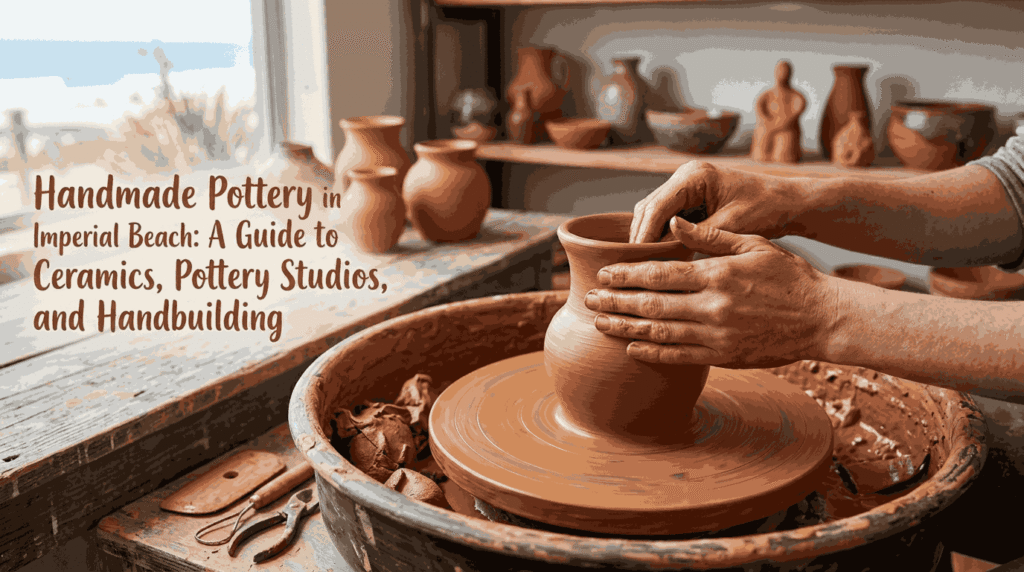
If you are interested in handmade pottery in Imperial Beach, you are exploring an art form that combines creativity, patience, and craftsmanship. Pottery allows you to turn a simple piece of clay into something useful, decorative, and personal.
Imperial Beach is part of the San Diego area, making it a convenient place for people who want to explore local ceramics, pottery classes, and creative studios. Whether you are a beginner or an experienced ceramic artist, there are many ways to enjoy working with clay.
From handbuilding and wheel throwing to glazing and firing, pottery offers a hands-on creative experience. You can also explore nearby communities for additional classes, studios, and open studio opportunities.
This guide explains what handmade pottery is, how it is made, where pottery enthusiasts can explore ceramics around Imperial Beach, and some of the questions people commonly ask about pottery.
What Is Handmade Pottery?
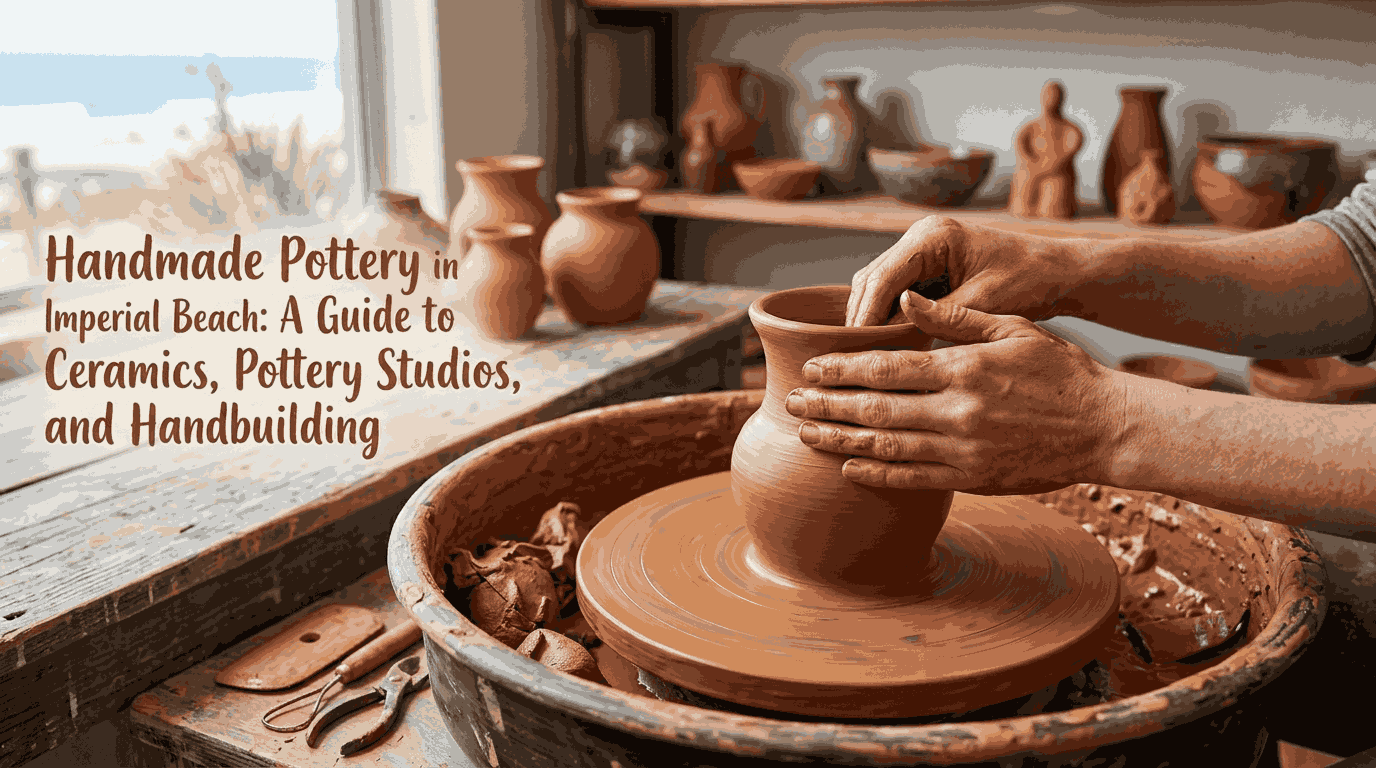
Handmade pottery refers to ceramic objects that are shaped by hand rather than being produced entirely through automated industrial processes.
Artists can use several techniques to create handmade pottery. These include handbuilding, wheel throwing, carving, coiling, and slab construction.
The process generally begins with clay. The clay is shaped into the desired form and then allowed to dry before being fired in a kiln. Depending on the piece, the artist may apply glaze before a second firing.
Because handmade pottery involves individual craftsmanship, each piece can have its own characteristics. Small differences in texture, shape, color, and surface decoration are often part of what makes handmade ceramics special.
Handmade Pottery in Imperial Beach San Diego
People searching for handmade pottery in Imperial Beach San Diego are often interested in more than buying finished ceramics. Many want to learn how pottery is created.
Working with clay can provide a relaxing and creative activity. You can experiment with shapes, textures, patterns, and colors while developing practical skills.
For beginners, handbuilding is often an approachable way to start. You do not need to master a pottery wheel immediately. Instead, you can learn basic techniques using your hands and simple tools.
As your skills develop, you can explore more advanced techniques and create increasingly complex pieces.
Why Is Handmade Pottery So Popular?
Handmade pottery has remained popular because it combines function with artistic expression.
A handmade mug, bowl, vase, or plate can be useful while still showing the personality of the person who made it.
There is also a creative freedom that comes with handmade ceramics. You can choose the shape, surface texture, glaze, and decorative details.
Furthermore, no two handmade pieces need to look exactly alike.
That individuality is one reason ceramic art continues to attract beginners and experienced artists alike.
What Is It Called When You Make Pottery by Hand?
One of the most common questions beginners ask is:
What is it called when you make pottery by hand?
The general term is handbuilding.
Handbuilding is a pottery-making method in which clay is shaped primarily with the hands and simple tools rather than being formed on a pottery wheel.
There are three common handbuilding techniques:
- Pinch pottery
- Coil building
- Slab building
Each technique produces different forms and textures.
Pinch Pottery
Pinch pottery is one of the simplest ways to begin working with clay.
The artist starts with a ball of clay and uses their fingers to gradually press and shape it. By pinching the clay between the fingers and thumb, the maker can create bowls, cups, small sculptures, and other forms.
Because the technique is simple, pinch pottery is particularly suitable for beginners.
Coil Building
Coil building involves creating long, rope-like pieces of clay called coils.
The coils are placed on top of one another and joined together. Artists can then smooth the surface or leave some of the coil texture visible.
This technique makes it possible to create larger and more sculptural forms.
Slab Building
Slab building uses flat sheets of clay.
Artists roll or press clay into slabs and then cut and join the pieces to create a form. This technique works particularly well for plates, trays, boxes, planters, and geometric pottery.
With practice, artists can combine slabs with other handbuilding methods to create unique designs.
Handbuilding vs. Pottery Wheel
Handbuilding and wheel throwing are both important pottery techniques. However, they provide different creative experiences.
With handbuilding, you have direct control over the clay using your hands and tools. This makes it easier to create irregular, sculptural, or geometric forms.
Wheel throwing involves shaping clay on a rotating pottery wheel. It is particularly useful for creating symmetrical objects such as bowls, cups, vases, and cylinders.
Neither technique is necessarily better.
Instead, your choice depends on the type of pottery you want to create.
Many ceramic artists eventually learn both.
Exploring San Diego Ceramics
The broader San Diego ceramics community offers opportunities for people interested in pottery, sculpture, glazing, and other forms of ceramic art.
Ceramics can include much more than traditional pots.
Artists may create:
- Sculptures
- Wall art
- Functional dinnerware
- Vases
- Planters
- Tiles
- Decorative objects
- Figurines
- Architectural ceramics
Local classes and studios can also provide access to equipment that may be difficult to have at home.
For example, a pottery studio may provide wheels, kilns, clay, glazes, work tables, and specialized tools.
As a result, joining a ceramics studio can be an excellent way to learn while meeting other people interested in the same art form.
Pottery in Encinitas and Other San Diego Communities
People interested in ceramics may also search for pottery Encinitas and other pottery opportunities throughout San Diego County.
Exploring different communities can be useful because studios may specialize in different areas.
One studio might focus on beginner classes. Another could emphasize wheel throwing. A different space may offer sculpture, glazing workshops, or open studio time.
Therefore, it is worth comparing programs based on what you want to learn.
If you are primarily interested in handbuilding, look for classes that specifically teach pinch, coil, and slab techniques.
On the other hand, if your goal is to become comfortable with a pottery wheel, choose a program with dedicated wheel-throwing instruction.
What Is a Pottery Open Studio?
A pottery open studio is a studio environment where artists can work independently during scheduled hours.
Open studio sessions are generally different from structured beginner classes.
Instead of following a complete lesson, participants usually work on their own projects. Depending on the studio, members may have access to pottery wheels, work surfaces, tools, clay, glazes, and kiln services.
For people searching for a pottery open studio near me, this can be an excellent option after learning the basics.
Open studio time allows you to practice regularly. It can also help you develop your own artistic style.
However, studio rules vary. Some spaces require membership, while others offer open studio sessions as part of a class package.
Before joining, ask about:
- Studio hours
- Membership fees
- Clay requirements
- Kiln firing fees
- Glaze availability
- Equipment access
- Storage space
- Studio rules
- Experience requirements
This will help you choose a studio that fits your needs.
What Should Beginners Expect From a Pottery Class?
A beginner pottery class usually starts with the fundamentals.
You may learn how to prepare clay, shape basic forms, prevent cracks, and understand the firing process.
If the class focuses on handbuilding, you may begin with pinch pots or simple slab projects.
Wheel classes generally introduce:
- Centering the clay
- Opening the clay
- Pulling the walls
- Shaping the form
- Trimming the piece
At first, the process can feel difficult.
That is normal.
Clay responds to pressure, moisture, speed, and technique. Developing control takes practice.
With regular sessions, however, many beginners become more comfortable and start creating more consistent forms.
How Is Handmade Pottery Made?
Although individual processes vary, handmade pottery generally follows several stages.
Step 1: Choosing the Clay
Different clay bodies have different properties.
Some are better suited to handbuilding, while others are designed for wheel throwing or sculpture.
The firing temperature also matters because the clay must be compatible with the kiln and glaze.
Step 2: Preparing the Clay
Clay often needs to be prepared before shaping.
Wedging can help create a more consistent material and reduce problems caused by air pockets or uneven moisture.
Step 3: Forming the Pottery
The artist then creates the desired shape.
This may involve handbuilding, wheel throwing, molding, carving, or a combination of techniques.
Step 4: Drying
The piece needs to dry gradually.
Rapid or uneven drying can cause cracks and other problems.
Potters therefore need to manage the drying process carefully, especially with larger or thicker pieces.
Step 5: First Firing
Once the clay is completely dry, it can be fired in a kiln.
This first firing is commonly known as the bisque firing.
After firing, the clay becomes a hard ceramic material that can be glazed.
Step 6: Glazing
Glaze adds color, texture, and a protective surface.
Artists can apply glaze using brushes, dipping, pouring, spraying, or other techniques.
The final appearance can change significantly during firing, so understanding the glaze and kiln temperature is important.
Step 7: Final Firing
The glazed piece is fired again.
The heat causes the glaze to mature and become part of the ceramic surface.
The finished piece is then ready for display or, when designed for functional use and properly fired with suitable materials, everyday use.
What Is the Most Sought-After Pottery?
Another interesting question is:
What is the most sought-after pottery?
There is no single type of pottery that is universally considered the most desirable.
Interest can depend on craftsmanship, cultural history, rarity, artist reputation, age, condition, provenance, and collector demand.
Some collectors look for historic ceramics. Others prefer contemporary studio pottery.
Handmade functional pieces can also be highly valued because they combine artistic qualities with everyday usefulness.
For many pottery enthusiasts, however, the most meaningful piece is not necessarily the most expensive one.
A handmade object connected to a memorable experience, artist, class, or place can have personal value that goes beyond its market price.
Why Is Talavera Pottery So Expensive?
Talavera pottery is a distinctive style of earthenware traditionally associated with Mexico and Spain.
People sometimes ask why Talavera pottery can be expensive.
Several factors can influence the price.
First, handmade production requires time and skill. Artists may shape, decorate, and glaze pieces individually.
Second, detailed painted designs can require significant labor.
Third, authenticity and provenance can influence collector interest.
Finally, larger or more complex pieces naturally require more materials and production time.
Therefore, the price of a Talavera piece is not determined simply by the amount of clay used.
Craftsmanship, decoration, history, authenticity, and demand can all contribute to its value.
Famous Potters From Santa Clara Pueblo
Santa Clara Pueblo has a significant pottery tradition and is known for distinctive black and red pottery.
Several Native American ceramic artists from Santa Clara Pueblo have become well known for their work and influence.
Notable potters include Maria Martinez, who is strongly associated with the development and recognition of blackware pottery from the San Ildefonso Pueblo tradition, although she was not from Santa Clara Pueblo.
For Santa Clara Pueblo specifically, important pottery families and artists include members of the Tafoya family, including Margaret Tafoya, who became one of the best-known Santa Clara Pueblo potters.
Her work helped bring wider recognition to Santa Clara pottery while maintaining traditional techniques and forms.
Santa Clara pottery demonstrates how ceramics can preserve cultural knowledge while also allowing individual artists to develop their own styles.
The Cultural Importance of Handmade Ceramics
Pottery is more than an art activity.
Across different cultures, ceramics have been used for cooking, storing food, serving meals, religious practices, decoration, and storytelling.
Traditional pottery can also preserve techniques passed from one generation to another.
For this reason, learning about ceramics should include an appreciation for the cultural traditions behind different forms of pottery.
When exploring pottery from a particular community or culture, it is important to recognize the artists, history, and traditions associated with the work.
How Pottery Can Encourage Creativity
Working with clay provides a different type of creative experience from drawing or digital design.
You can touch the material, change its shape, add texture, remove material, and build it again.
That physical process encourages experimentation.
A beginner might start with a simple bowl and gradually learn to make handles, lids, textured surfaces, sculptural forms, and more complex pieces.
Mistakes can also become part of the creative process.
A slightly uneven surface or unexpected texture may ultimately give a piece more character.
Pottery as a Relaxing Creative Activity
Many people enjoy pottery because it encourages them to slow down.
Working with clay requires attention.
You need to observe its moisture, pressure, shape, and texture. That focus can make a pottery session feel very different from activities involving screens or fast-paced work.
For this reason, pottery classes can be enjoyable even for people who do not plan to become professional ceramic artists.
You can simply make something, learn a new skill, and enjoy the creative process.
How to Choose a Pottery Studio Near Imperial Beach
If you want to find a pottery studio near Imperial Beach, consider your experience level and preferred technique first.
A beginner may benefit from an instructor-led class.
An experienced potter might prefer an open studio.
You should also consider the studio’s equipment and firing options.
Before signing up, ask:
- Does the studio teach handbuilding?
- Are pottery wheels available?
- Is open studio time offered?
- Are kilns available?
- Are glazes included?
- Is clay included in the class fee?
- Can students keep their finished pieces?
- Are beginner classes available?
- How often can members use the studio?
These questions can help you avoid choosing a studio that does not match your goals.
Handmade Pottery Makes a Meaningful Gift
Handmade pottery can also make a thoughtful gift.
Because every piece can have individual characteristics, handmade ceramics often feel more personal than mass-produced objects.
Popular choices include:
- Handmade mugs
- Bowls
- Vases
- Planters
- Decorative tiles
- Serving dishes
- Ceramic sculptures
You can also give a pottery class or studio experience to someone who enjoys creative activities.
That type of gift provides an experience rather than simply another physical object.
Why Learn Pottery at Art Wheel?
Art Wheel provides an opportunity for people interested in exploring ceramics and developing their skills in a creative environment.
Whether you are completely new to clay or want to develop your existing abilities, learning through hands-on practice can help you understand the pottery process.
Students can explore the fundamentals of working with clay while developing their own creative ideas.
Handbuilding is particularly accessible because it allows beginners to create forms without first mastering a pottery wheel.
As you become more comfortable, you can experiment with different shapes, textures, surface treatments, and decorative techniques.
Frequently Asked Questions
What is handmade pottery?
Handmade pottery is ceramic work shaped and finished through individual craftsmanship. Artists may use handbuilding, wheel throwing, carving, coiling, slab construction, and other techniques.
What is it called when you make pottery by hand?
Making pottery by hand is generally called handbuilding. Common handbuilding techniques include pinch pottery, coil building, and slab building.
What are the main handbuilding pottery techniques?
The three main handbuilding techniques are pinch, coil, and slab construction. Potters can also combine these methods to create more complex forms.
Is pottery difficult for beginners?
Pottery requires practice, but beginners can learn the fundamentals through structured classes. Simple handbuilding projects are often a good starting point.
What is a pottery open studio?
A pottery open studio provides scheduled access to a ceramics workspace where artists can work independently. Studio policies, equipment, fees, and experience requirements vary.
Where can I find a pottery open studio near me?
If you are looking for a pottery open studio near Imperial Beach or elsewhere in San Diego County, compare studios based on location, equipment, hours, membership requirements, and the techniques they support.
What is the most sought-after pottery?
There is no single type of pottery that is universally the most sought-after. Value can depend on craftsmanship, rarity, history, cultural significance, artist reputation, condition, and collector demand.
Why is Talavera pottery so expensive?
Talavera pottery can be valuable because of its handmade production, detailed decoration, craftsmanship, cultural history, authenticity, and the time required to produce individual pieces.
Who are some famous potters from Santa Clara Pueblo?
Margaret Tafoya is one of the best-known Santa Clara Pueblo potters. Her work helped bring international attention to Santa Clara pottery and its traditional forms.
What is San Diego ceramics?
San Diego ceramics refers broadly to ceramic art, pottery, sculpture, classes, studios, and ceramic communities throughout the San Diego region.
Can beginners learn handbuilding?
Yes. Handbuilding is one of the most accessible ways to begin learning pottery because it does not require prior experience with a pottery wheel.