
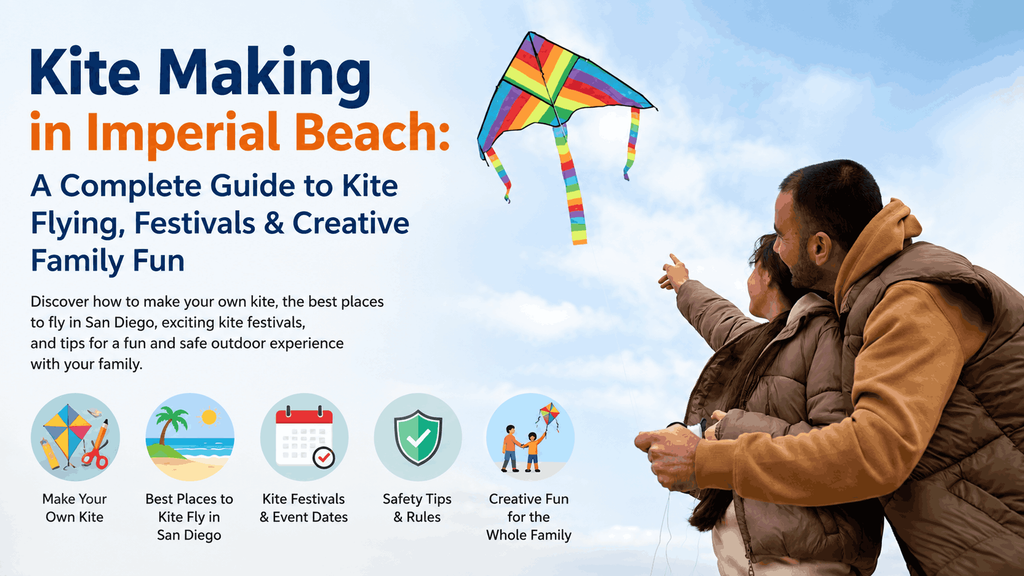
Kite making is a simple and creative activity that combines art, design, movement, and outdoor fun. For families, children, students, and anyone who enjoys hands-on crafts, making a kite can be just as exciting as flying one.
If you’re searching for kite making in Imperial Beach, you’re in a great location to enjoy creative activities and coastal outdoor experiences. Imperial Beach is part of San Diego’s South Bay, while the wider San Diego area offers opportunities for kite flying, festivals, workshops, and family-friendly activities.
The best part about making a kite is that you don’t need expensive materials or advanced skills. You can start with lightweight paper, sticks, string, tape, and some creative decorations. Once your kite is ready, you can take it outdoors and see how well your design performs in the wind.
In this guide, we’ll cover how to make a kite, where to fly kites in San Diego, local kite festivals, public kite-flying rules, and the Washington State International Kite Festival 2026.
What Is Kite Making?
Kite making is the process of designing and building a kite from lightweight materials. A basic kite may include:
- Lightweight paper or fabric
- Bamboo or thin wooden sticks
- String
- Tape
- Glue
- Ribbons
- Markers, crayons, or paint
- Other lightweight decorations
The goal is to create a structure that is light enough to fly while remaining balanced and stable in the wind.
Although kite making looks simple, it can teach several useful skills. Children and beginners can learn about design, symmetry, balance, construction, creativity, and problem-solving while creating their own kite.
Why Is Kite Making a Great Creative Activity?
Kite making offers something different from many indoor activities. Instead of simply using a finished toy, children can design and build something themselves before taking it outdoors.
A family can make the activity collaborative. One person can design the kite, another can help construct the frame, and someone else can decorate it. Once the kite is finished, everyone can head outside and test it.
This combination of art, construction, science, and outdoor activity makes kite making a great choice for:
- Family weekends
- School projects
- Community events
- Children’s activities
- Creative workshops
- Outdoor gatherings
Kite Making in Imperial Beach
If you’re interested in kite making in Imperial Beach, you can combine a creative project with the area’s coastal atmosphere and outdoor recreation.
Your kite-making activity doesn’t have to begin at the beach. You can design and build the kite at home, in a classroom, or during a creative workshop before taking it outside for testing.
For beginners, a simple diamond-shaped kite is a good starting point because its construction is relatively straightforward.
Step 1: Choose a Kite Design
Start with a simple design that matches your skill level.
Common kite designs include:
- Diamond kites
- Delta kites
- Sled kites
- Box kites
- Parafoil kites
- Decorative kites
A lightweight diamond kite is often a practical choice for children who are making a kite for the first time.
Step 2: Build the Frame
The frame provides the kite with its structure.
Use lightweight sticks to create the basic shape. The frame should be strong enough to support the kite but light enough to allow it to rise in the wind.
Step 3: Attach the Sail
The sail is the main surface that catches the wind.
Depending on the design, you can use lightweight paper, fabric, or another suitable material. Attach the material securely to the frame and make sure there are no unnecessary heavy sections.
Step 4: Decorate the Kite
This is where you can get creative.
Try adding:
- Bright colors
- Geometric patterns
- Flowers
- Animals
- Ocean designs
- Abstract artwork
- Names or initials
- Inspirational messages
Children can create completely different designs even when they begin with the same basic kite template.
Step 5: Attach the Flying Line
The flying line should be securely connected to the appropriate point on the kite.
The position of the connection can affect the way the kite responds to the wind, so make sure it is properly attached before flying.
Step 6: Add a Tail if Necessary
Some kite designs benefit from a tail because it can improve stability.
You can use lightweight ribbons, fabric strips, or paper streamers. A colorful tail can also make the kite more attractive while it is flying.
How to Make a Simple Kite at Home
You don’t need specialized equipment to make a basic kite at home.
Materials You May Need
- One large sheet of lightweight paper
- Two lightweight sticks
- String
- Tape
- Scissors
- Glue
- Ribbons
- Markers or crayons
Simple Kite-Making Process
- Draw the outline of your kite.
- Carefully cut the kite shape.
- Create a lightweight cross-frame.
- Attach the frame to the paper.
- Reinforce the corners with tape.
- Attach the flying line.
- Add a tail if the design requires one.
- Decorate your kite.
- Take it to a suitable outdoor location.
- Test it in a steady breeze.
The balance of the kite is particularly important. If one side is significantly heavier than the other, the kite may spin, tilt, or struggle to climb.
Kite Making and Art: Why They Work Together
A kite can be thought of as a flying piece of art.
Unlike artwork that stays on a wall, a kite changes as it moves through the sky. Its colors, shape, and decorations become part of an outdoor experience.
This makes kite making a natural extension of other hands-on creative activities such as:
- Pottery
- Painting
- Sculpture
- Handbuilding
- Drawing
- Craft projects
At Art Wheel, the focus is on hands-on creative experiences that allow people to work with physical materials and express themselves through making.
The same creative mindset applies to kite making:
Design it. Build it. Experiment with it. Then enjoy the result.
What Is the Best Weather for Kite Flying?
You don’t necessarily need strong wind to fly a kite. In fact, very strong winds can make kite flying difficult and may create safety risks.
For beginners, a steady, moderate breeze is generally easier to manage.
Before heading outside, consider:
- Wind speed
- Wind direction
- Weather conditions
- Nearby trees
- Power lines
- Buildings
- Crowds
- Local restrictions
Avoid flying a kite during thunderstorms or when lightning is present.
Where Are the Best Places to Kite Fly in San Diego?
San Diego has many parks, beaches, and open recreational areas. However, not every location is automatically suitable for kite flying.
Always check current rules and posted signs before flying.
1. Tecolote Shores
Tecolote Shores in Mission Bay is one location specifically identified by San Diego’s tourism organization as a place for kite flying.
The surrounding Mission Bay area provides large recreational spaces, making open areas particularly useful for activities that require room for a kite to rise.
2. Fiesta Island
Fiesta Island is another large recreational area in Mission Bay.
Its open environment can make it attractive for outdoor activities. However, visitors should check current park regulations, closures, environmental restrictions, and safety notices before flying a kite.
3. Ocean Beach
Ocean Beach has a strong connection to kite flying because it hosts the annual Ocean Beach Kiwanis Children’s Kite Festival.
The area provides a beach environment where visitors can enjoy outdoor activities. However, crowded beaches require additional care.
When flying, stay away from:
- Swimmers
- Surfers
- Crowded areas
- Buildings
- Other recreational activities
4. Imperial Beach Area
Imperial Beach also offers a coastal environment where visitors can enjoy outdoor recreation.
However, it’s important to distinguish between ordinary recreational kite flying and kiteboarding.
Kiteboarding involves specialized equipment and uses a kite to propel a person across the water. Imperial Beach has specific regulations for kiteboarding, including rules related to launching and riding.
Those regulations should not automatically be interpreted as rules for a small recreational kite.
Before flying, check the signs and regulations for the specific location you plan to use.
What Date Is the Kite Festival?
One of the best-known kite events in the San Diego area is the Ocean Beach Kiwanis Children’s Kite Festival.
The 79th Ocean Beach Children’s Kite Festival took place on Saturday, May 16, 2026, from 10 a.m. to 3 p.m. at Robb Field.
The event featured activities such as:
- Free kite making
- Kite decorating
- Kite flying
- Professional kite demonstrations
- Age-group competitions
- Kite games
- Food vendors
- Local artisans
- Community booths
The festival has been running since 1948 and is described by the City of San Diego as the oldest continuously running children’s kite festival in the United States.
Festival Location
Robb Field
2525 Bacon Street
San Diego, CA 92107
For families interested in kite making in Imperial Beach, this type of event demonstrates how creative activities and outdoor recreation can come together.
What Happens at the Ocean Beach Kite Festival?
The Ocean Beach Children’s Kite Festival is designed to encourage participation rather than simply watching professional flyers.
According to the 2026 event information, visitors could make and decorate their own kites, participate in contests and games, and watch professional kite demonstrations.
Activities included:
- Tail Chase
- Tail Touching
- Candy Drop
- Aerial demonstrations
- Quadline team flying
The event also featured a grand finale with quadline team flying.
For children, the opportunity to make a kite and then watch or participate in kite-flying activities can make the experience especially memorable.
Is It Illegal to Fly a Kite in a Public Place?
Not necessarily.
Flying a kite in a public place is not automatically illegal everywhere. Rules can vary depending on the city, park, beach, county, and type of activity.
There is also a difference between:
- Recreational kite flying
- Kiteboarding
- Organized kite events
- Commercial activities
- Large group activities
Some locations may have specific restrictions or authorization requirements.
For example, certain San Diego County park regulations address kites and similar devices and may require written authorization for their use in particular circumstances.
Therefore, don’t assume that one rule applies to every park or beach.
The safest approach is to check the regulations and posted signs for the exact location before flying.
Can You Fly a Kite on San Diego Beaches?
The answer depends on the specific beach and circumstances.
Before flying a kite, choose an open area away from:
- Swimmers
- Surfers
- Children playing nearby
- Buildings
- Trees
- Power lines
- Roads
- Parking areas
- Drones
- Other kites
You should also check posted signs and local regulations.
A kite line can become a hazard if people walk through it, particularly on busy beaches.
Always prioritize safety and be considerate of other beach visitors.
Kite Flying vs. Kiteboarding: What’s the Difference?
The word “kite” can refer to several different activities.
Recreational Kite Flying
Traditional recreational kite flying involves holding a kite line while the kite flies above you.
Examples include:
- Diamond kites
- Delta kites
- Decorative kites
- Stunt kites
Kiteboarding
Kiteboarding is a water sport where a specialized kite is used to propel a person on a board.
It requires specialized equipment, training, and safety procedures.
Therefore, someone searching for kite making in Imperial Beach is generally interested in traditional recreational kite making and flying rather than kiteboarding.
Is There a Kite Festival in Washington State in 2026?
Yes.
The Washington State International Kite Festival (WSIKF) took place in Long Beach, Washington, from August 17 through August 23, 2026.
The 2026 festival marked its 45th year.
The event takes place during the third full week of August each year and attracts kite flyers and visitors interested in large-scale kite displays and competitions.
What Can You See at the Washington State International Kite Festival?
The Washington State International Kite Festival is significantly larger than a typical local kite-flying gathering.
The week-long celebration includes activities such as:
- Professional kite demonstrations
- Kite competitions
- Giant inflatable kites
- Mass kite ascensions
- Children’s kite making
- Handcrafted kite displays
- International kite flyers
- Vendors
- Family activities
The Washington Kitefliers Association describes the festival as a seven-day celebration featuring competitions, demonstrations, international flyers, giant inflatables, children’s kite making, handcrafted kite judging, and mass ascensions.
The festival takes place on the wide beaches of Long Beach, Washington, creating an impressive setting for large and colorful kite displays.
Why Kite Festivals Are Great for Children
Kite festivals can offer children more than entertainment.
They can introduce young participants to several useful concepts.
Creativity
Children can design and decorate their own kites.
Engineering
They can discover how shape, weight, structure, and balance affect whether an object can fly.
Science
Kite flying provides a simple introduction to concepts such as:
- Wind
- Lift
- Drag
- Balance
- Direction
Outdoor Activity
Kite flying encourages children to spend time outdoors and interact with their surroundings.
Social Interaction
Festivals can provide opportunities to participate in games, workshops, competitions, and group activities.
Confidence
Successfully flying something they made themselves can give children a strong sense of accomplishment.
Kite Making as a Family Activity
One of the biggest advantages of kite making is that people of different ages can participate.
Parents can help with construction.
Children can focus on decoration.
Older kids can experiment with different shapes and designs.
Adults can help test and adjust the kite.
Instead of spending the entire weekend on screens, a family can create something together and then enjoy it outdoors.
That combination of making and doing can create a more memorable experience than simply purchasing a ready-made kite.
Creative Kite Design Ideas
If you’re organizing a kite-making activity, consider one of these themes.
Ocean-Themed Kite
Use:
- Blue
- Turquoise
- White
- Fish
- Waves
- Shell patterns
An ocean theme is especially appropriate for a coastal community such as Imperial Beach.
Animal Kite
Decorate your kite with animals such as:
- Birds
- Butterflies
- Dragons
- Fish
- Ladybugs
Rainbow Kite
Create a colorful rainbow pattern across the kite.
Personalized Kite
Add the child’s:
- Name
- Initials
- Favorite colors
- Favorite animals
- Favorite designs
California-Themed Kite
Use California-inspired imagery such as:
- Beaches
- Palm trees
- Sunsets
- Ocean waves
- Flowers
Tips for a Successful Kite-Making Activity
Whether you’re planning a family project or a creative workshop, a little preparation can make the activity much easier.
Keep the Design Simple
Younger children may have more fun with a simple kite design that is easy to construct.
Use Lightweight Materials
Heavy decorations can prevent the kite from flying properly.
Reinforce Connection Points
Make sure the frame and flying line are securely attached.
Don’t Overload the Kite
A heavily decorated kite may look beautiful but may not fly well if it becomes too heavy.
Check the Balance
If the kite spins or falls repeatedly, check the bridle, tail, frame, and weight distribution.
Choose an Open Area
Stay away from trees, buildings, roads, power lines, and crowded spaces.
Be Patient
A first kite may not fly perfectly.
That’s part of the fun.
Making adjustments and trying again can turn the activity into a valuable learning experience.
How Kite Making Encourages Creative Thinking
One of the most valuable parts of kite making is experimentation.
A child may build a kite that doesn’t fly correctly. Instead of viewing this as a failure, encourage them to ask:
Why didn’t it work?
Perhaps:
- One side is heavier.
- The frame is too flexible.
- The tail is too short.
- The kite is too large.
- The flying point is positioned incorrectly.
The child can make an adjustment and test the kite again.
This simple process turns kite making into a practical lesson in problem-solving, observation, and experimentation.
Kite Making and Other Hands-On Art Activities
Kite making fits naturally into the broader world of hands-on creative activities.
Pottery, painting, sculpture, handbuilding, and kite making all encourage people to create something rather than simply consume something.
At Art Wheel, visitors can explore hands-on creative experiences such as pottery wheel and handbuilding activities in Imperial Beach.
For someone who enjoys designing, building, and experimenting with a kite, other hands-on art activities can provide another way to explore creativity and personal expression.
Why Imperial Beach Is a Great Place for Creative Experiences
Imperial Beach offers a combination of coastal scenery, outdoor recreation, community spaces, and access to the greater San Diego area.
That makes it a natural setting for activities that connect creativity with outdoor experiences.
You can spend part of your day designing and building something and then head outdoors to enjoy the coastal environment.
For families, couples, visitors, and local residents, this creates an experience rather than simply another activity to check off a list.
Planning a Kite Day in Imperial Beach
If you’re planning a kite-making and flying day, consider a simple schedule.
Morning: Design and Decoration
Begin by choosing the kite design, preparing the materials, and decorating the sail.
Late Morning: Construction
Finish attaching the frame, flying line, and tail if required.
Afternoon: Test the Kite
Choose an appropriate open location and test the kite in a steady breeze.
Take a Break
Enjoy a picnic or explore the surrounding area.
Later: Experiment
Try different flying techniques or make adjustments to improve the kite’s stability.
Before heading outside, always check the weather, local conditions, posted signs, and regulations for your chosen location.
Frequently Asked Questions About Kite Making and Kite Festivals
What is kite making?
Kite making is the process of designing, constructing, decorating, and balancing a kite so it can fly. It combines creativity, basic construction, and an introduction to wind and aerodynamics.
Where can I do kite making in Imperial Beach?
You can explore creative activities in Imperial Beach and participate in kite-making events throughout the wider San Diego area. The Ocean Beach Children’s Kite Festival, for example, includes kite-making activities and kite-flying opportunities.
What date was the San Diego kite festival in 2026?
The 2026 Ocean Beach Kiwanis Children’s Kite Festival was held on May 16, 2026, from 10 a.m. to 3 p.m. at Robb Field.
Where are the best places to kite fly in San Diego?
Tecolote Shores is specifically identified by San Diego’s tourism organization as a kite-flying location. Fiesta Island is another large recreational area to consider, subject to current rules, conditions, and restrictions.
Is it illegal to fly a kite in a public place?
Not everywhere. Rules depend on the specific location and the type of kite activity. Some parks or public areas may have restrictions or authorization requirements, so check local regulations before flying.
Is there a kite festival in Washington State in 2026?
Yes. The Washington State International Kite Festival took place in Long Beach, Washington, from August 17–23, 2026.
What materials do I need to make a kite?
Common materials include lightweight paper or fabric, thin sticks, string, tape, glue, scissors, markers, and ribbons.
Is kite making good for children?
Yes. Kite making can encourage creativity, patience, problem-solving, hand-eye coordination, and interest in outdoor activities.
What wind is best for kite flying?
A steady, moderate breeze is generally easier for beginners than very strong or highly variable wind. Avoid flying during thunderstorms or dangerous weather conditions.
Final Thoughts on Kite Making in Imperial Beach
Kite making in Imperial Beach is more than a simple craft project. It combines creativity, construction, science, outdoor recreation, and family time in one enjoyable activity.
Whether you’re designing a simple diamond kite at home, attending a local kite festival, exploring suitable kite-flying locations around San Diego, or planning a creative family day, the process gives everyone an opportunity to make something and experience it outdoors.
If you enjoy hands-on creativity, kite making can also be a great starting point for exploring other artistic activities such as pottery, painting, and handbuilding.
The most important thing is to keep the activity creative, safe, and enjoyable. Design your kite, build it, test it, make adjustments, and then watch your creation take to the sky.